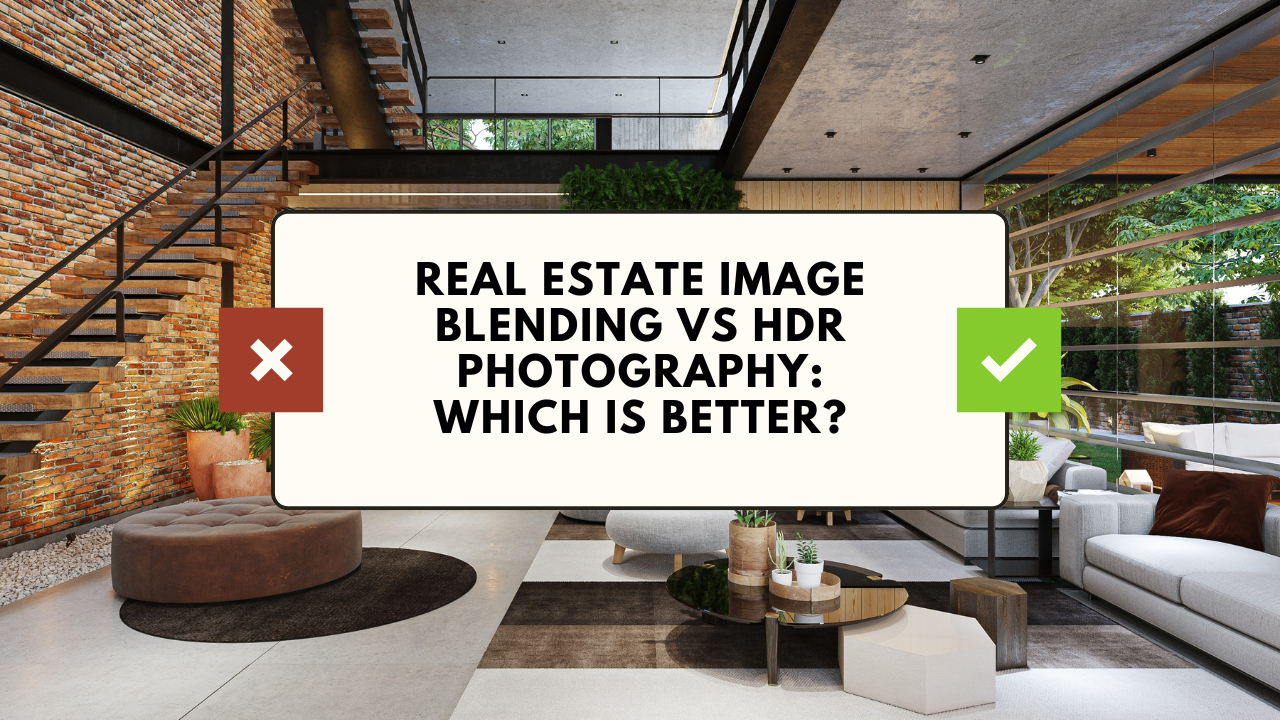
First impressions in real estate happen online – and they happen fast. Before a buyer ever steps through the front door, they’ve already judged your listing based on how the photos look on a screen. That’s why the debate around Real Estate Image Blending vs HDR Photography isn’t just a technical conversation among photographers – it’s a business conversation that directly affects how quickly a property sells and at what price.
Both techniques aim to solve the same core problem: cameras struggle to capture the full range of light that the human eye sees naturally. A bright window in a living room, for example, will either blow out into white nothingness or leave the interior looking dark and uninviting – unless you use one of these two methods to fix it. But they go about solving that problem in very different ways, and the results can be dramatically different.
Let’s break it all down so you can make an informed decision for your next listing.
Understanding HDR Photography in Real Estate
HDR, or High Dynamic Range photography, has been around for quite a while and remains a popular choice among real estate photographers – particularly those looking for a faster, more automated workflow. The technique involves shooting multiple exposures of the same scene (typically three to seven brackets) and then merging them using software like Photomatix, Aurora HDR, or even Lightroom’s built-in HDR merge tool.
The software automatically blends the darkest and brightest exposures together, pulling detail from shadows and highlights simultaneously. In theory, it sounds perfect. In practice, however, HDR has a well-known Achilles’ heel: it tends to produce images that look over-processed, artificial, or – in the worst cases – almost painterly and surreal.
Common Issues with HDR in Real Estate Photography
- Ghosting artifacts: When anything moves between exposures, a ceiling fan, a curtain, even a plant swaying, the blended result shows blurry, ghost-like outlines that look unprofessional and distracting.
- Unnatural color tones: HDR software tends to over-saturate colors and introduce strange color casts, making warm wood floors look orange or white walls appear grey or yellow.
- Halo effects around windows: One of the most common HDR complaints is the glowing “halo” that appears around window frames when the software struggles to blend extreme exposure differences.
- Loss of depth and realism: Because HDR flattens the tonal contrast across the entire image, the result often lacks the natural depth that makes a room feel three-dimensional and inviting.
None of this means HDR is useless, but it does mean that achieving professional, print-quality results with HDR requires a highly skilled photographer and significant post-processing time to correct the software’s automatic mistakes.
What Is Real Estate Image Blending?
Real Estate Image Blending is a manual, precision-based editing technique where a skilled retoucher hand-selects and blends multiple exposures together using professional software, most commonly Adobe Photoshop, along with luminosity masks, layer masks, and manual dodging and burning tools.
Unlike HDR, which relies on an algorithm to make all the blending decisions, image blending puts a trained human eye in control of every single decision. The editor chooses exactly which part of which exposure gets used in the final image, ensuring that the result looks the way the property actually looks – bright, spacious, clean, and realistic.
The difference in final output quality is often striking. With image blending, window views remain sharp and properly exposed. The interior retains warm, natural lighting. Colors stay true. And there’s none of the artificial “glow” or color distortion that plagues automated HDR outputs.
Read Also- Top 5 Tools for Perfect Image Blending and How to Use Them
How the Real Estate Image Blending Process Works
A typical blending workflow starts with the photographer capturing a base ambient exposure, one or more flash exposures (to light the interior evenly), and a window pull exposure (optimized to show the view outside or control the bright window light). These are then sent to an editor – often through a professional Real Estate Image Blending Company – who manually combines them in Photoshop using layer masks to create a perfectly balanced final image.
The result is a photograph that looks like the property was shot on the most perfect lighting day imaginable – because every element of the image has been carefully controlled and optimized by a human expert.
Real Estate Image Blending vs HDR Photography: A Side-by-Side Comparison
To make things concrete, here’s how these two techniques compare across the factors that matter most to real estate professionals:
| Factor | Image Blending | HDR Photography |
|---|---|---|
| Realism & Natural Look | Excellent – human-controlled, true-to-life | Often over-processed and artificial |
| Window Exposure Quality | Clean, sharp, fully controlled | Frequently produces halos and blown areas |
| Ghosting Issues | Easily corrected manually | Common problem, difficult to fix automatically |
| Color Accuracy | True-to-life color tones | Often over-saturated or color-shifted |
| Turnaround Time | Slightly longer (manual process) | Faster (mostly automated) |
| Cost | Moderate – competitive with outsourcing | Lower upfront, but may require corrections |
| Best Use Case | Luxury listings, high-end properties, editorial | Volume photography, budget-sensitive projects |
Why Real Estate Agents Are Shifting Toward Image Blending
The real estate market has become intensely visual. Platforms like Zillow, Realtor.com, and countless social media channels reward listings that look clean, bright, and professionally photographed. Buyers have grown more sophisticated; they can tell when a photo looks artificial, and that creates doubt about the property before they even schedule a viewing.
This shift in buyer expectations is one of the biggest reasons more agents and developers are choosing professional Real Estate Image Blending Services over the automated HDR approach. When a listing photograph looks realistic and inviting, buyers trust what they see. That trust translates into more inquiries, more showings, and ultimately, faster sales at stronger prices.
High-end property developers and luxury real estate agents, in particular, have almost entirely moved away from HDR. When you’re selling a $2 million home, a photograph that looks over-processed or artificial can actively hurt your brand image. The investment in proper image blending pays for itself many times over.
Read Also- Real Estate HDR Photo Editing Trends Every Photographer Should Know
The Role of Flash in Image Blending
One important technical advantage of image blending over HDR is the use of off-camera flash. By introducing controlled artificial light into the scene, photographers can eliminate the harsh shadows and uneven lighting that plague many interior shots. The flash exposures are then blended with the ambient and window exposures to create an image with balanced, even light throughout the room – something HDR, which only works with available light, simply cannot replicate.
When Does HDR Still Make Sense?
To be fair, HDR photography isn’t without its place. For high-volume real estate photography companies handling dozens of budget properties per week, the speed advantage of automated HDR processing is a genuine business benefit. When the margin per property is tight and the client’s expectation is simply “good enough,” HDR can deliver acceptable results quickly.
Similarly, exterior shots – where ghosting and color issues are less pronounced – can still benefit from HDR processing without the technique’s typical weaknesses becoming visible. A wide-angle shot of a property’s facade against a dramatic sky, for example, can be handled effectively with HDR if done carefully.
But for any listing where quality is the primary concern – and in today’s market, it almost always should be – image blending is the stronger choice.
Conclusion
When weighing up Real Estate Image Blending vs HDR Photography, the answer comes down to what you want your listing photos to communicate. HDR offers speed and automation, but at the cost of realism and image quality. Image blending requires more skill and care, but it delivers photographs that look natural, polished, and genuinely representative of the property.
For real estate agents, property dealers, and developers who understand that photography is one of the highest-leverage marketing investments they can make, the choice is clear. Partnering with a reliable real estate image blending company to produce hand-crafted, expertly blended photographs is not an expense – it’s a competitive advantage that pays dividends every time a buyer clicks on your listing and decides it’s worth their time to find out more.
In real estate, the camera doesn’t just capture a property. It captures attention, builds trust, and opens doors. Make sure the photos doing that job are the very best they can be.
FAQs: Real Estate Image Blending vs HDR Photography
1. What is the main difference between Real Estate Image Blending and HDR photography?
The core difference lies in how exposures are combined. HDR photography uses automated software algorithms to merge multiple exposures into a single image, often resulting in an artificial, over-processed look. Real Estate Image Blending, on the other hand, is a manual process where a skilled editor carefully combines specific exposures by hand in Photoshop, resulting in a far more natural and realistic final image. For professional real estate marketing, image blending typically delivers superior results.
2. Is Real Estate Image Blending more expensive than HDR?
The cost difference is often smaller than people assume, especially when you factor in the corrections and rework that HDR images frequently require. Many professional editing services and outsourcing companies offer competitive pricing for manual image blending. When you consider the return on investment – better-looking photos that generate more buyer interest and faster sales – the slightly higher cost of image blending is almost always justified, particularly for mid-range to luxury properties.
3. How many exposures are typically used in Real Estate Image Blending?
Most professional real estate photographers capture three to five exposures for a blended image: a base ambient exposure, one or more flash-lit exposures to balance the interior lighting, and a window pull exposure to properly render the view outside or manage the bright light coming through windows. The exact number depends on the complexity of the scene, the lighting conditions, and the editor’s preferred workflow. Some challenging rooms may require additional exposures to achieve the desired result.
4. Can HDR photography be fixed in post-processing to look like image blending?
To some extent, yes – a skilled editor can reduce the artificial look of HDR images through careful post-processing adjustments. However, this approach is often more time-consuming than simply starting with a proper blending workflow from the beginning. Additionally, some HDR artifacts – particularly ghosting caused by movement between exposures – are very difficult or impossible to fully correct after the fact. Starting with the right technique always produces better results than trying to fix the wrong one.
5. How do I choose the right Real Estate Image Blending company for my listings?
Look for a company with a strong portfolio of completed real estate work that demonstrates natural-looking results across a range of property types and lighting conditions. Turnaround time, pricing transparency, and communication quality are also important factors. Ask whether they use Photoshop-based manual blending or rely on automated HDR tools – the answer will tell you a great deal about the quality of output you can expect. Reading client reviews and requesting a trial edit before committing to a long-term relationship is always a smart approach.